Cookie settings
We use necessary cookies for basic functionality, analytics cookies for visitor statistics and ad conversion tracking (Google), and functional cookies for Spotify content.



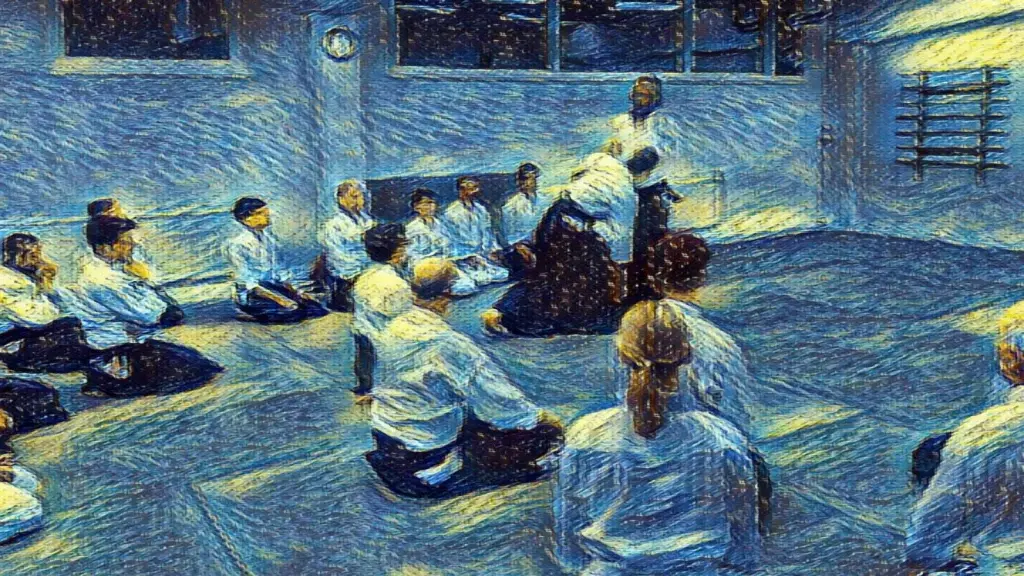
Can you start aikido as an adult? The answer is yes. Starting as an adult is the most common way to begin aikido. Of Aikido Unlimited’s main instructors, Mikko started at 22 and Sarita at 40. Many teachers who have taught for decades began surprisingly late. Some had other martial arts behind them first — but today most practitioners start in middle age with no martial arts background at all.
If you are considering starting in Tampere or Hyvinkää, a free trial class is the lowest-barrier way to try. You can also read what to expect from your first class.
Why adults often fit aikido especially well
Aikido is a demanding art — and that is often easier to understand later in life. Younger students more easily focus on collecting techniques, flashy ukemi, and fast, pseudo-realistic self-defense posturing. Adults more often see how practice enriches life beyond the practical benefits.
Even so, physical work on the mat often matters more to adults than to younger students. The dojo gives body and mind something desk work does not.
When the body no longer tolerates harder arts
Many people come to aikido from other arts because of its softness and body-friendliness. They still care about martial practice, but their body no longer handles harder styles. Aikido can then be a compelling option: it keeps a martial structure, while pace and intensity can be adapted to your situation.
For a comparison of arts, see aikido vs judo. There is also a separate piece on whether aikido is self-defense.
Aikido is an “inner” art
Aikido is an “inner” art: meaning is found in how your own body feels and moves, brought into interaction with a partner and into technique. The most important measure is how it feels to you. If the technique felt good, it was good.
“Am I athletic enough as a training partner?”
Adult beginners often worry about physical limits. Am I athletic enough as a partner? Some movements would have been nicer to learn young. Younger partners do spectacular ukemi, hit hard, and kick high. How could I ever reach the same level as people who started younger?
Those thoughts are understandable — and, from the perspective of someone who has trained for a long time, largely irrelevant. On the mat we train the mind through practice. We move toward our own aim, from our own starting point.
Ukemi — safe falling — is taught progressively; see Afraid of Falling?.
Practice from your own target state
At the start of class I sometimes ask people to imagine a target state for the end of the session: how do you want your body to feel afterward, and what kind of thoughts do you want moving through your mind? Once that is clear, I ask them to practice in a way that reflects it.
What we think shows in what we do — and the other way around. Personally I want to leave class energized, flexible, and playful. I want my body to feel that I have done something physical: not so much strength training as whole-body aerobic movement with wide ranges of motion.
When practice starts from your own mind and body use, external factors — age and other people’s opinions — start to lose weight. Teachers and fellow students support you on the path, but practice is each person’s own, from each person’s own starting point.
How to start as an adult
Starting is simple: book a free trial class, or join the basic course. See also start aikido — adults and pricing.
Age is not a barrier. Often it is exactly why aikido starts to feel like yours.
-Mikko Kurkela