Cookie settings
We use necessary cookies for basic functionality, analytics cookies for visitor statistics and ad conversion tracking (Google), and functional cookies for Spotify content.

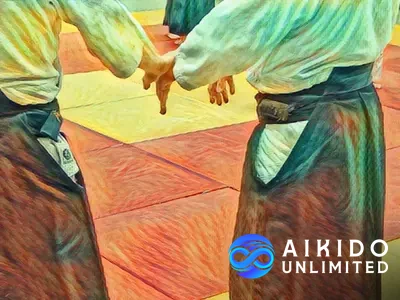
New students are always welcome at Aikido Unlimited. You do not need to know etiquette, Japanese terms, or techniques beforehand — and you do not need to worry about holding experienced students back.
On the contrary: guiding beginners is part of training for more advanced students. When a more experienced practitioner shows, explains, and trains with you, they are also practicing their own understanding, safety, and cooperation.
Our classes usually have at least two instructors. That way there is enough time and support for newcomers, and no one has to get through the first class alone.
Etiquette is learned together — you do not need it ready-made
Etiquette is an important part of aikido, but nobody expects newcomers to know it when they walk in. You will get guidance on the spot, and other students will help.
Class begins in a line. We ask a training partner to practice by saying Onegai shimasu.
In this context it means roughly this: we place ourselves in situations where the other person could theoretically hurt us — and we ask that they do not. We train in cooperation, supporting each other's development.
At the end of class we line up again and thank our training partners by saying Arigato gozaimasu — “thank you very much”.
During practice there is no hierarchy among students. Belt rank or experience does not make anyone more valuable. The class instructor leads the session, but everyone on the mat is equally valued.
Japanese terms may feel overwhelming at first. They stick quite quickly in practice. We have also created a quiz game to help you get familiar with the terms at home.
What to wear and how to prepare
For your first class, any indoor sportswear is fine. We practice barefoot for safety reasons. If you cannot be barefoot, you can wear tabi socks or other socks with enough grip.
Any martial arts uniform is fine. Traditionally aikidoka wear a white judo-style keiko gi, but an aikido gi is often lighter and has shorter sleeves. You do not need to buy a uniform before trying the art.
We hope that students:
- keep training clothes clean
- keep fingernails and toenails short
- do not wear makeup
- do not wear jewelry
If something such as an earring cannot be removed, it should be taped so it does not endanger the wearer or their training partners.
For deeper background on hygiene and caring for a shared dojo, see Small Things Matter.
How does a class progress?
A typical class goes roughly like this:
- Opening lineup
- Warm-up (aikitaiso)
- Movement practice, such as ukemi (falling) and taisabaki (evasions/footwork)
- Technical practice
- More free-form practice
- Closing
At Aikido Unlimited each class is usually built around one basic topic. We start simply and build toward more advanced exercises during the hour.
You can sit out any exercise if it feels like too much. If you leave the tatami area, please tell the instructor.
We train together — across experience levels
New students normally practice with more experienced ones as well. We aim to train with everyone, regardless of experience, size, skill, or gender. That is one aspect of our training: learning to work with different kinds of people.
Typically exercises are done in pairs. The more experienced student usually takes the more difficult role first. One person does about four repetitions, then roles switch, and you continue until new instructions are given.
There are usually two roles:
- Uke provides the training energy and the attack
- Nage (or tori) performs the technique
Uke's role is often more demanding, because the attack needs to fit the exercise. If the attack is not correct, the technique is hard to do well. Do not worry: that too is part of practice, and giving a good attack takes time to learn.
Beginner summary
- Do I need to know anything beforehand? No.
- Will a beginner hinder experienced students? No — guiding newcomers is part of training.
- Are there enough instructors? Classes usually have at least two.
- What should I wear? Indoor sportswear is enough; barefoot or gripping socks.
- Can I skip an exercise? Yes. Tell the instructor if you leave the mat.
If you are thinking about starting, the easiest way is to book a trial class or sign up for the basic course. You will get guidance on the spot — you only need to show up.
-Mikko Kurkela