Cookie settings
We use necessary cookies for basic functionality, analytics cookies for visitor statistics and ad conversion tracking (Google), and functional cookies for Spotify content.

What is aikido in practice?
A Japanese martial art that uses the attacker's movement and energy.
In short
What is aikido in practice? Aikido is a Japanese martial art in which techniques are performed by using the attacker's movement and energy. Through practicing martial skills, we learn interaction and cooperation — and get enjoyable exercise at the same time.
Aikido took shape in Japan in the twentieth century based on the teachings of Morihei Ueshiba. It draws on elements of traditional martial skills, but emphasizes blending, movement, and partner work rather than force. Today aikido is practiced worldwide with different emphases — here the focus is clear teaching, safety, and training together.
Who can start?
Practitioners shape aikido to fit their own interests. Some are drawn to self-defense, others to acrobatic throws, and others to community. At Aikido Unlimited we aim to give a broad picture of aikido practice, with a focus on interaction and training together.
Aikido has no competitions or matches. The ranking system is also not a measure of level, but a tool for teaching the art's content in a structured way. If you are looking for a sense of danger, or aggressive, straightforward fighting skill, aikido is not the right hobby for you. Still, aikido offers plenty of challenge — whether your interest is closer to self-defense or moving meditation.
You do not need a prior martial arts background to start. Many people step onto the mat for the first time as adults — sometimes precisely because they want exercise without competition. What matters is interest in learning and willingness to practice with a partner. Fitness does not need to be ready in advance: it develops through training.
Benefits usually show up in ordinary ways: better body awareness, more confident movement, and the experience of learning something new as an adult. We do not promise self-defense miracles or quick mastery. We offer regular practice, guidance, and a community where you can progress at your own pace.
How we train
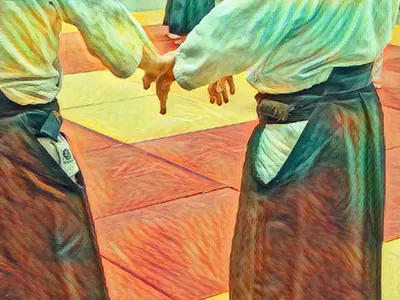
Aikido techniques are rooted in traditional Japanese martial skills, but they are meant to be performed by using the attacker's energy. The techniques include various joint locks, throws, strikes, and kicks. Aikido also includes practice with wooden sword (bokken), jo staff, and knife.
Because our focus is not on the most efficient fighting or succeeding in competition, we can concentrate on learning together and having fun — with the martial context providing an interesting playing field.
Training progresses step by step: first safety and body awareness, then basic technique forms, and later freer application. That is why the same group can include beginners and more experienced practitioners — everyone trains at their own level. To learn more about everyday dojo life and our approach, see about us or the blog.
A typical class includes a warm-up, falling practice, and partner techniques. You can adjust the tempo: sometimes you move calmly and precisely, sometimes more freely. Weapons practice is introduced gradually. Training develops balance, mobility, and body awareness — without promises of miracles. Benefit comes from consistency: repetition, feedback, and a safe environment. That is why we recommend coming more often than once a month when you can — learning builds in small steps.
What you learn in the first classes
In the first sessions we practice safe falling, basic movement, and simple partner techniques. You do not need to know etiquette or Japanese terms in advance — you get guidance on the spot. Classes usually have more than one instructor, so beginners get enough support.
The first visit is often about getting oriented: how the mat feels, how partners rotate, and how the class flows. You do not need your own uniform at first — loan gear is enough. If something feels unclear, ask directly; the dojo is for learning, not for looking skilled from day one. Many people worry for no reason — beginners are common, and they get extra guidance when needed.
If you are wondering how aikido differs from judo, for example, read aikido vs judo. You can also book a free trial class or explore the basic course.
In short: aikido is practice where you learn to move together, fall safely, and use techniques without competitive pressure. It suits many people, but not everyone — and the best way to know is to try. If you want clear guidance and a community, you are welcome on the mat.