Cookie settings
We use necessary cookies for basic functionality, analytics cookies for visitor statistics and ad conversion tracking (Google), and functional cookies for Spotify content.

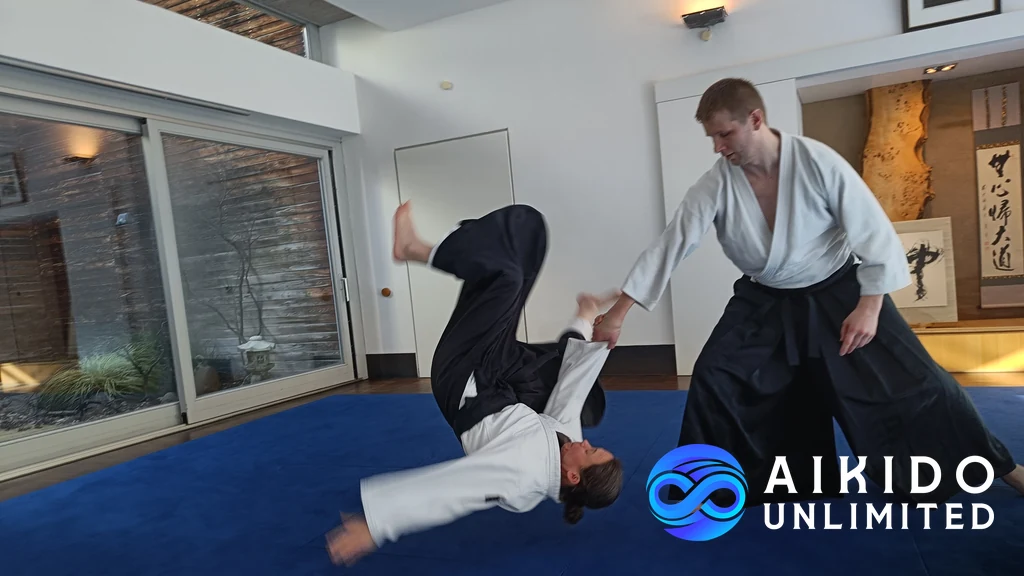
Afraid of falling? It is one of the most common questions before starting aikido. Short answer: safe falling — ukemi — is practiced from the beginning, slowly and progressively. Nobody needs to take high breakfalls on the first class. Ukemi is also one of aikido’s most concrete everyday benefits: when falling is controlled, a slip on the street or a bicycle fall can end more softly.
Below we explain what ukemi is, why it is practiced so much, how learning progresses at Aikido Unlimited, and who benefits most. If you are considering starting, you can book a trial class or read what to expect from your first class.
What is ukemi?
Ukemi means the ability to receive a throw or a fall safely — softly, roundly, and under control. Aikido is known for soft and sometimes spectacular ukemi, and falls are practiced a lot especially at the beginning.
For an experienced aikidoka, falling often happens without thinking. At the dojo you hear stories of people who slipped on the street or fell off a bike and unconsciously took a soft ukemi. That is not magic — it is body memory built by repetition.
Why practice ukemi so much?
Ukemi is not only self-protection. It is also a core part of training so that uke — the attacker and receiver of the technique — can give the person doing the technique as much energy as possible. The more energy uke gives, the more demanding the ukemi usually becomes.
Without good ukemi, the person doing the technique often has to stop mid-movement and imagine the rest: “And from there, if the attack continued, I would turn this wrist…” If that turn is never practiced for real, it is hard to learn later either.
That is why uke and tori need each other. You can read more about the same partnership in The Dance of Machine and Operator.
How is ukemi taught today?
Traditional ukemi teaching was often trial and error: sensei and senpai threw younger students, and the fall simply had to round out. Today ukemi is usually taught more carefully through a clear progression.
- Slowly from the ground — forward and backward, without rush.
- From standing at your own pace — once the roll starts to feel familiar.
- Guided by a partner — ukemi in a soft, controlled throw.
- Higher ukemi — with the thrower securing support; later also alone at a calm pace, for example over a partner’s back.
- Into techniques — once higher ukemi starts to work, they are practiced with an experienced thrower who manages support and the direction of the movement.
Little by little the skills grow, and uke can take a soft ukemi from almost any position. The progression is intentionally safe: speed and height increase only when the foundation is solid.
Who benefits most from ukemi?
Ukemi often feels easier for smaller and lighter students — but larger practitioners benefit from it the most. When a larger person falls, the forces are always greater, and an uncontrolled fall is always a risk.
Juniors can come down from throws in almost any way without hurting themselves. For the biggest people on the mat, falling must always be controlled. So ukemi is not “only for beginners” — it is a safety skill for every student.
Ukemi as a safety factor in the dojo
When uke can fall in different directions, even in a tighter space you can still do reasonably dynamic techniques safely. If needed, uke can take a firmer grip and turn a high ukemi so they do not roll into the neighboring pair or into the wall.
Good ukemi therefore protects both yourself and others — it is a shared safety culture in the dojo, not just acrobatics.
Do you need high ukemi for grading?
Today high ukemi is no longer a requirement in grading curricula, though it remains a recommendation. The idea is that nobody’s progress in aikido should be blocked by fear of high falls.
That does not mean high ukemi is not worth practicing. It expands the safe space you can move in on the mat and deepens your understanding of the energy in techniques — at your own pace.
Ukemi as exercise and body control
In ukemi you go to the ground and stand back up. A skilled uke uses the movement’s energy to rise again, but uke’s role is still often the most physical part of an aikido class.
Getting up from the tatami especially loads the legs and the support muscles of the core. For older practitioners, sufficient leg strength becomes especially important — and the same strength shows up in everyday life as better balance. Ukemi is therefore both a budō skill and practical body care.
Spectacular ukemi and shared flow
Some students are also drawn to the visual and acrobatic side of high ukemi. Spectacular demonstration falls demand strong body control, and practicing them is a bit like dance: working together with a partner is, for many, one of the main reasons to train aikido.
Finding a shared flow state is a powerful experience. It grows from trust: tori throws safely, uke gives energy and receives the fall softly. When you can safely push the practice with your partner and get the rhythm and timing perfectly in sync, the result is something you can later look back on and wonder how it worked — and try to find that feeling again.
Summary: falling does not have to be scary
- Ukemi = safe, soft falling — one of aikido’s concrete benefits.
- It is taught progressively: from the ground → standing → with a partner → higher ukemi → into techniques.
- Good ukemi makes better training possible for both: uke gives energy, tori can finish the technique.
- It is especially important for larger practitioners; for juniors, falling is often naturally easier.
- High ukemi is not a mandatory grading criterion, but it is still worth practicing at your own pace.
If falling worries you, that is normal — and exactly why it is practiced safely from the start. The easiest way to see what ukemi feels like in practice is a trial class or the basic course. You can also read what aikido is.
-Mikko Kurkela