Cookie settings
We use necessary cookies for basic functionality, analytics cookies for visitor statistics and ad conversion tracking (Google), and functional cookies for Spotify content.



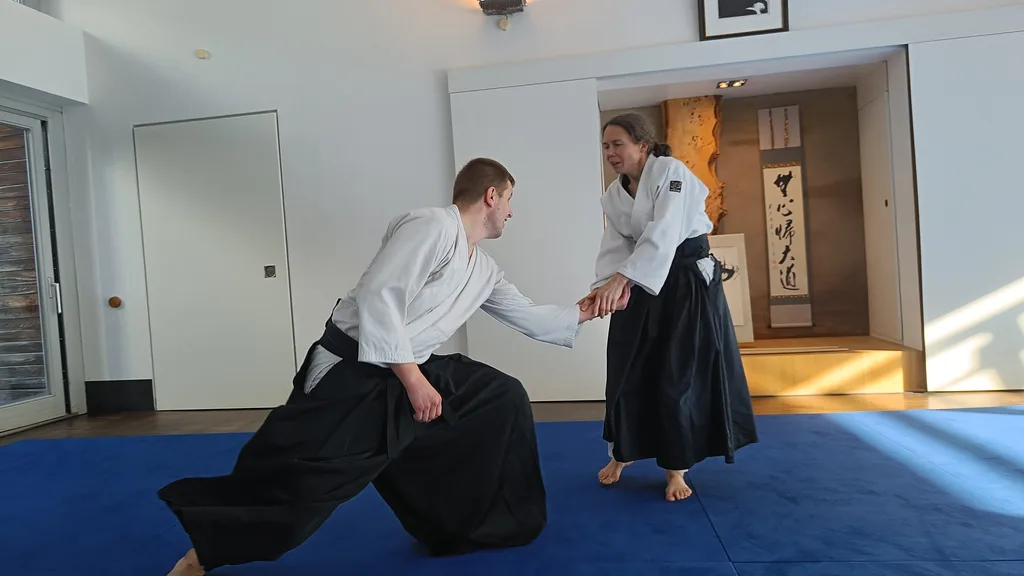
Aikido and BJJ (Brazilian jiu-jitsu) are both martial arts built around gripping, balance, and joint locks. Short answer to “which one is for me?”: technically the arts are closer than many assume — but training rhythm, competition culture, and whether you work mostly standing or on the ground set them clearly apart.
If you are choosing a hobby or moving from BJJ to aikido (or the other way around), it helps to understand both the overlaps and the differences — without a tribal fight between styles.
Similarities: the technical side is closer than you think
Many comparisons lean hard on philosophy and leave the technical overlap thin. In practice, the technical side of aikido and BJJ shares a lot: grips, levers, breaking balance, timing, and the idea that position and timing matter more than raw strength.
Both are practiced with a partner, not against empty air. Both teach you to read movement and respond to it. The difference is not that one is “technique” and the other is “force” — it is the training environment in which that technique is developed.
Standing vs on the ground
The biggest structural difference is the battlefield: aikido is mostly standing work — throws, entries, locks, and footwork. BJJ is built around taking the fight to the ground and finishing there.
Ground work in aikido is typically suwariwaza: kneeling versions of standing principles, not continuous mat fighting like BJJ. At Aikido Unlimited we still teach basic ground-fighting principles, especially for juniors — useful skills even when newaza is not the core of aikido.
A useful rule of thumb: BJJ without a competition focus often feels like aikido on the ground — the same technical curiosity and cooperative learning, just on a different plane.
How you train: jiyuwaza and flow rolling
This is where comparisons often mislead. Aikido is painted as “only forms” and BJJ as “always sparring.” Reality is more nuanced.
Technical drilling looks similar in both arts: break the movement down, repeat, correct. The difference is how much sparring-like practice the art includes — and that is shaped by whether competition is part of the culture.
Aikido has no mainstream competition system, so sparring-heavy training is less central than in BJJ. Still, aikido has free practice: jiyuwaza. It is quite close to BJJ flow rolling — continuous, flowing work at an intensity where both partners can learn.
The biggest cultural difference is the partner's role: in aikido the job is to help the other person learn more than to win. Resistance is useful and necessary for progress, but the goal is not points or a tap. In BJJ, live rolling is often closer to a match — though a good flow roll can feel very similar to jiyuwaza.
Competition and rules
In BJJ, competition is highly present: rules, weight classes, belts, and tournaments shape what gets trained. Competition-oriented training raises intensity and makes sparring a natural part of the week.
Aikido focuses on budō. Competition is uncommon, and training is built around cooperation, body control, and often a weapons-based fighting mindset. Without competition pressure there is less sparring-like practice — not because technique cannot be tested, but because the structure of the art does not require it the same way.
Distance, weapons, and multiple attackers
BJJ is clearly much closer-contact than aikido. Clinch, wrestling on the ground, and constant body weight on your partner are everyday training — and for many people that feels intimidating at first, even when the practice is friendly.
In aikido you get close to your training partner from time to time, but the contact is usually not as continuous or as “on top of you” as in BJJ. Distance is taken and given; closeness is often momentary, not the default setting of the whole class.
In aikido, weapons work (jo, bokken, tanto) influences everything — including empty-hand practice. There is also often an assumption of more than one attacker: you need to take and keep space.
BJJ usually focuses on one opponent, close range, and the ground. That does not make BJJ “worse” — it makes it a different tool for a different problem. If you come from BJJ into aikido, distance and movement logic can feel foreign at first even when locks and timing feel familiar.
Physical load
In BJJ, constant pressure, clinch, and ground work often load the neck, back, and knees. In aikido contact is often lighter, but ukemi — falling safely — is a skill of its own.
Neither art is automatically “safe.” Load depends on the group, the instructor, and the intensity you train at.
Belts and progression
Many people assume BJJ's belt system is clearer because belts are everywhere. In practice BJJ progression is often less transparent than in aikido: promotion depends heavily on the school, the instructor, and sometimes competition results. Criteria are not always easy to see in advance.
In aikido, grading usually has clearer criteria: specific techniques, ukemi, weapons work, and training time. That does not mean every dojo uses the same standard — but the path is often easier to understand up front.
Which one is for you?
- BJJ fits if you want ground fighting, a lot of live practice, and possibly competition. Without a competition focus, BJJ can feel a lot like aikido — just on the ground.
- Aikido fits if you want standing work, weapons practice, jiyuwaza-style flowing training, and a clearer grading path. Your partner's role is to help you learn, not to beat you.
You do not have to pick a side. Many people train both — and technical foundations transfer surprisingly well once you relearn distance and mindset.
Also read aikido vs judo, what aikido is, or what to expect from your first class. You can book a free trial class or join a basic course.
-Mikko Kurkela