Cookie settings
We use necessary cookies for basic functionality, analytics cookies for visitor statistics and ad conversion tracking (Google), and functional cookies for Spotify content.

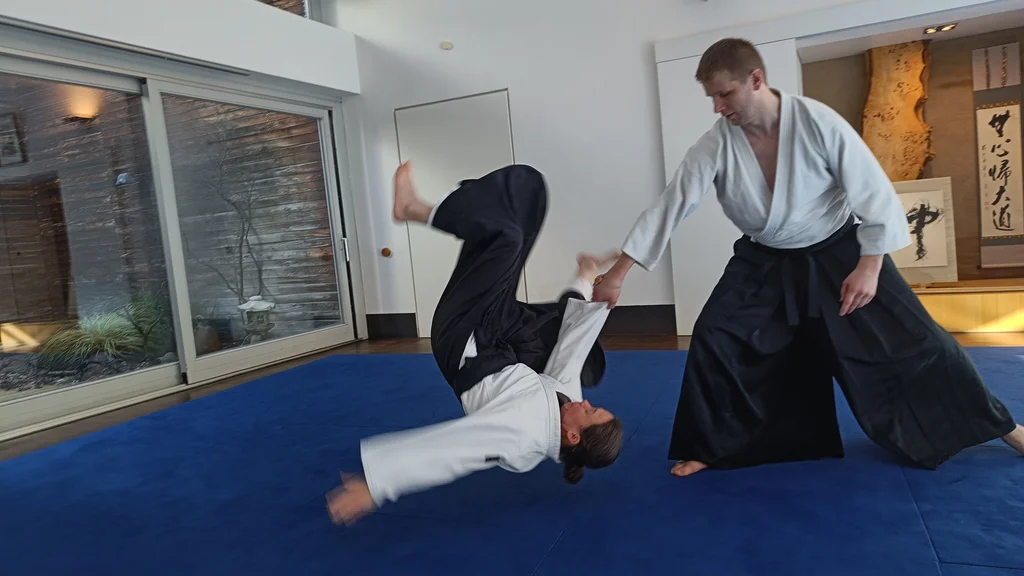
How did aikido arrive in Finland — and why do different teacher names still matter on the mat? Short answer: aikido reached Finland in 1970, organised into clubs and the Finnish Aikido Federation, spread across the country in the 1970s–1990s, and was strongly shaped by visiting Japanese teachers — and later also European ones. Below is a concise summary of Mika Levy’s master’s thesis Aikidon tie suomalaiseen liikuntakulttuuriin (University of Joensuu, 2006), plus a look at the main teacher lineages that still echo in Finnish dojos.
Looking for a place to train in Tampere? Read also Aikido in Tampere – where to train and how to start. You can begin with a free trial class.
Daito-ryu – the roots of aikido
Aikido grows out of Daito-ryu aiki-jujutsu, whose best-known transmitter was Sokaku Takeda. Morihei Ueshiba studied Daito-ryu under Takeda and later developed his own path — aikido. Historians and practitioners have also speculated whether Ueshiba was in practice still teaching Daito-ryu content, only under a new name and emphasis. There is no settled answer, but the link is clear: without Daito-ryu there would be no aikido as we know it.
In Helsinki you can still train Daito-ryu in at least two clubs: Fudoshin – Daitoryu (Takumakai line) and Vallgård Martial Arts’ Daitoryu Aikijujutsu.
What did Levy study?
Levy examines the history of aikido in Finland from 1970 to 2000: arrival, organisation, spread, education, and the role of Japanese teachers. The core question is how aikido integrated into Finnish sports culture — as fitness practice, lifestyle, and alternative movement culture, without competition.
According to the thesis, growth accelerated after revitalisation measures in the late 1970s and continued through the 1980s and 1990s. A Finnish peculiarity was a relatively unified club field: practice was built in voluntary associations, not primarily along Japanese-style “school” divisions. Acculturation reduced some of the “Eastern” surface and emphasised physical aspects, while staying outside competitive sport preserved many budō values.
How did aikido come to Finland?
Aikido was brought to Finland in 1970 by Japanese teacher Toshikazu Ichimura, invited from Sweden by Trygve Forsstén. After the first demonstrations, courses began. Early activity centred on Helsinki and Turku; soon the art spread to places such as Hämeenlinna, Hyvinkää, Tampere, Kotka, Kuopio and Kerava.
The beginning was not linear. In the mid-1970s practice faded in several towns due to a lack of instructors and training spaces. In 1977 the federation revitalised the art: leadership changes, publicity, inviting Japanese teachers, restoring the grading system, and founding a renewed organisation (Finland Aikikai). Growth then accelerated.
Organisation and spread
The Finnish Aikido Federation guided, coordinated and developed activity together with member clubs. Levy divides the spread into five periods and four channels (for example relocating practitioners, sections inside judo clubs, clubs splitting off, and visiting instructors from other towns). Club numbers grew clearly in the 1980s; by the 1990s towns with two or more clubs were already common.
Junior activity began in the early 1980s with continuity in mind. Tampere tried family aikido as early as 1980, and junior work became established in many towns through the decade. Coach education and seminars gradually shifted more to the clubs, while the federation focused on coordination, external relations and later supporting dan grading.
In 1986 Ichimura returned to Japan. Levy treats this as a turning point: without a single Nordic head instructor, Finnish aikido began to develop more independently, and contacts with other foreign teachers diversified.
Teacher lineages in Finland
The “voice” of Finnish aikido has largely been shaped by which Japanese teachers visited regularly and oversaw dan grading. Levy highlights especially four names among teachers invited by the federation in 1971–2000.
Toshikazu Ichimura – the Nordic beginning
Ichimura served as Hombu Dojo’s authorised Nordic head instructor from 1966 (Sweden) and taught in Finland from 1970, often for dozens of seminar days a year, until he left in 1986. He was the central authority of Finnish aikido’s first decade and a half: Levy credits him with the most federation-invited seminar days across the whole period.
Behind the departure were, among other things, strained personal relations, uncertain livelihood and pressure to change. For Finns it meant there was no longer one “father” who defined everything — after which the field opened to new teacher relationships.
Yasuo Kobayashi and Kazuo Igarashi – continuity in grading
Yasuo Kobayashi first visited Finland in 1977. He was Ichimura’s teacher, and his visit had lasting effects: the kyu grading system was restored, and the following year Kazuo Igarashi — also Kobayashi’s student — came to Finland. Igarashi coached for long periods in 1978–1979 in Helsinki, Turku and Kuopio.
After Ichimura left, Kobayashi and Igarashi were named by Hombu Dojo as the teachers responsible for Finnish dan grading. From 1987 they became the regular instructors of the national Easter and summer seminars. Levy describes how they gradually involved senior Finns in examining — aiming at a more independent Finnish grading practice.
Seishiro Endo – a softer line in the 1990s
A third key teacher responsible for dan grading in the 1990s was Seishiro Endo. He first visited Finland privately in 1986; the federation organised his seminar in 1988. Relations with Endo in Scandinavia were built in part by Matti Joensuu and Lennart Linder. Endo’s line — influenced also by O-Sensei’s student Seigo Yamaguchi — later became important for many Finnish clubs, including Aikido Unlimited.
Shoji Nishio – from weapons to body technique
Shoji Nishio sensei once had a fairly wide influence on Finnish aikido. His weapons work — especially ken and jo — strongly shaped body techniques as well: weapons practice was not a side track, but a way to understand movement. Today the most active club following that lineage is Aikiken in Jyväskylä. Earlier the impact on the Finnish scene was clearly larger; now it is rarer, but still recognisable.
Michio Hikitsuchi and the Kumano line
O-Sensei’s student Michio Hikitsuchi and his students have had a strong impact especially in Oulu, Raahe, Kuopio, Hyvinkää and Lappeenranta. Many Finnish aikidoka have trained at Kumano Juku Dojo in Japan. The French teacher Gérard Blaize, of the same lineage, has visited Finland regularly — particularly in the Oulu area. This line also practises bo weapons.
Christian Tissier and the French line
French teacher Christian Tissier and his students have a strong following in Finland. In Helsinki, for example, Awase Aikido, AikiCircle and Finn-aiki follow this line closely. Tissier already visited Finland on federation invitation in the late 1980s; later, club-level contacts kept the line alive.
Ki-aikido
Ki-aikido is a small but important style in Finland. One of the main influences has been Rainer Varis. Ki-aikido branched into its own school early on and has lived alongside the Aikikai-based club field.
Shodokan aikido
Juha-Matti Ahola also teaches Shodokan aikido in Finland. The style is characteristically structured and curriculum-oriented. Shodokan has a competition format, but no competitions have ever been held in Finland.
Steven Seagal’s lineage
There is also a small group in Finland following Steven Seagal’s aikido lineage. Jarmo Humalajoki may have been the most active figure on that line. Clubs practising it include Alajärvi Aikido Club Yawara Nage and Rovaniemi Aikido Club.
Other Japanese visitors
During Levy’s period the federation also invited other Japanese teachers, including Seiichi Sugano, Katsuaki Asai, Minoru Kanetsuka and Moriteru Ueshiba (for example at the 20th anniversary seminar in 1990 and around the World Games in 1997). In the 1990s clubs increasingly invited teachers on their own initiative — Japanese and European — and shared travel costs.
Levy stresses that although the range of visitors grew, the federation kept a clear line on who mattered most for dan grading and national seminars. At the same time, club-level initiative diversified what Finnish tatami sounded like.
Finland’s first shihan
Finnish aikido’s growing self-reliance is also marked by the first teachers awarded shihan: Juhani Laisi, Jukka Helminen and Petteri Silenius. Their work — teaching, seminars, organisation and international contacts — has been central to Finnish aikido no longer depending on a single external authority.
A Finnish curiosity: EFO
On the fringe of aikido and aiki tradition, Finland also produced a curiosity: EFO (Empty Force), which claims to stop an attacker without contact — by “force of thought”. The best-known Finnish figure on that line has been Jukka Lampila. Yle’s Jaakko Keso tried the art in his documentary EFO väittää kaatavansa ajatuksen voimalla — and found that not everything is quite what it seems. The episode belongs to Finnish budō folklore: a reminder to keep both an open mind and a healthy scepticism on the mat.
What followed into today?
Levy’s period ends in 2000, but its traces — and later lineages — remain. Finnish aikido mostly runs through clubs within the federation, without competition, yet dojos carry different teacher lines: Endo, Kobayashi–Igarashi, Nishio, Hikitsuchi, Tissier, ki-aikido, Shodokan and others. In Tampere, for example, Nozomi, Seigikai and Aikido Unlimited draw partly on the same names with different emphases. More in the Tampere post.
To try practice, book a trial class or join the basic course. For what aikido is as an art, see what is aikido.
Summary
- Aikido grows out of Daito-ryu aiki-jujutsu; in Helsinki it is practised at clubs such as Fudoshin and VMA.
- Aikido reached Finland in 1970 with Ichimura and organised into clubs and the federation.
- Main Aikikai dan-grading lines in Levy: Ichimura, then Kobayashi and Igarashi, plus Endo in the 1990s.
- Finland also hosts Nishio, Hikitsuchi, Tissier, ki-aikido and Shodokan lines — with different weight in different towns.
- First Finnish shihan: Juhani Laisi, Jukka Helminen and Petteri Silenius.
- Source (history 1970–2000): Mika Levy, Aikidon tie suomalaiseen liikuntakulttuuriin (2006).
-Mikko Kurkela